
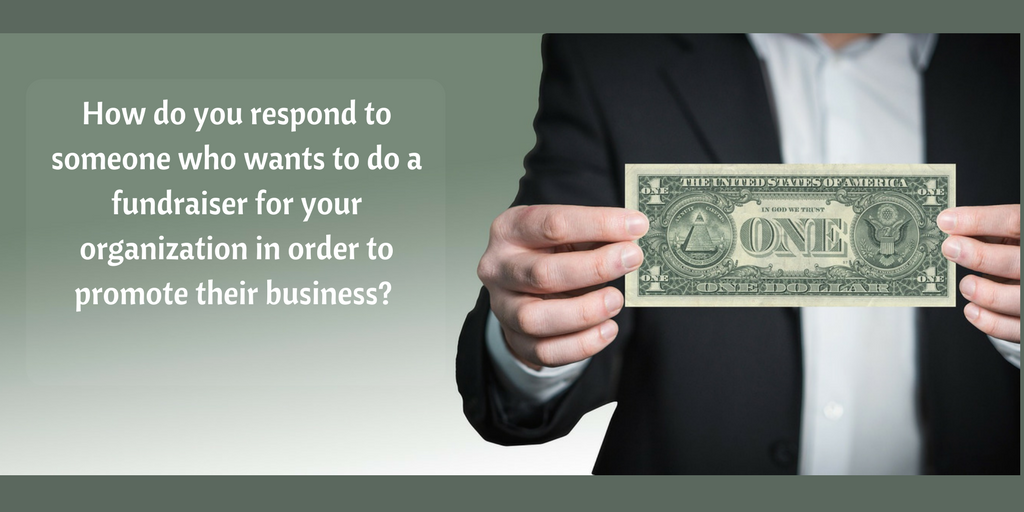
3rd party fundraiser events are common today. That doesn’t mean you should accept one. So should you accept an offer of a business to do a fundraiser for your organization?
The answer is: it depends.
On the surface, it seems like a wonderful idea doesn’t it? Wow, someone wants to raise money for you?
But it’s not that simple.
First, it’s your reputation, so choose the company wisely – do your own research and vetting. What if the business isn’t aligned with your mission? And, what’s the likelihood of the event being successful?
Second, what do they want from you? It might truly be something where they do all the work with no involvement from you, and they just send the check for the proceeds. But in many cases, they only want to give you a percentage of the proceeds (as low as 10%).
Red flag the offer if these are part of the 3rd party fundraiser request
They want to:
- use your social media to broadcast the event to your followers (or even worse, want you to use your staff’s time to promote the event, create and send emails, postings, and fliers.)
- use your staff and volunteers on the day of the event to manage activities.
- send thank yous and receipts to everyone who participates financially. (if you’re a small staff, this is particularly challenging).
- use your liability insurance for the event.
- get you to invite all of your supporters to the event – if you’ve been busy cultivating your donors and their engagement, imagine what a confusing message this sends!
Other questions you might ask
Have they successfully done a 3rd party fundraiser for another organization, and if so, how much did they raise for the charity? (Are they also affiliated with that charity, and is that an appropriate charity to be linked to yours?) If they raised $25,000 and all you have to do is show up on the day of the event and say a few words, it might be worth it.
Does it tie to your mission? If it ties to your mission such as pet supplies for an animal welfare group, or a tech firm putting on a technology expo and you’re focused on getting girls into coding and technology, it might make sense to partner.
Will they sign a 3rd party fundraising agreement?
This is a board-approved document that outlines:
- the permissions to use organizational materials, logo, or any indication of affiliation only for this event including a point about not altering the logo for their purposes, or not.
- your discretion as to whether you are able and or willing to post the 3rd party fundraiser on official organization social channels and website.
- how charitable receipts will be handled. For example, cash must be accompanied with the identifying donor’s information, address, etc. And, that donations must be given to the organization within 30 days of the end of the event. Or, that you will not provide receipts, and the dollars raised cannot be considered a charitable donation for individuals but only to the business.
- most importantly, that your organization will not be held liable for any issues, injuries, damages to persons or property, or any other incidents that arise during your 3rd party fundraiser event.
- get it signed in advance of the event. And make sure your board approves the event.
Third party fundraiser events can be a wonderful thing if the business really has the charity’s best interests in mind. But the charity must weigh the “cost” in time, staff, and donor engagement/confusion before acceptance. If it seems too good to be true, it just might be.

 Most importantly, you need an understanding among all staff (and that includes program people) that fundraising and relationship building are part of everyone’s job! It’s not the responsibility of one person. Fundraising is important programmatic work.
 process, you know that you are setting up a culture that won’t serve you well. I’ve heard about why from governance committees: Fear. Fear that a potential board member will be scared away. But in worrying about scaring them off before they join, you’re forgetting one very important factor. And that factor is the passion they feel for your sector. And that they believe you have the solution to an important community issue. But, that’s just the beginning. A strong board culture includes:
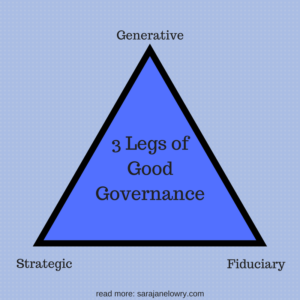 cond leg, includes setting priorities for your organization, developing and improving various strategies you’re using to meet your mission, and then monitoring their performance. This is often delegated to staff to monitor with very little board oversight. Spend at least 20 minutes of your board meeting on strategic discussion. The third leg of good governance is generative: not just doing work better; but ensuring your organization does better work. Generative thinking includes probing assumptions held in how you decide things, and living the organizational values that should be driving strategy and tactics. Generative mode is often where board members spend the least amount of time, and yet that’s where real governance truly happens. It’s how you make leaps forward. Remember, boards exist to supplement management expertise by asking a different set of questions. High-performing boards spend time in generative mode.
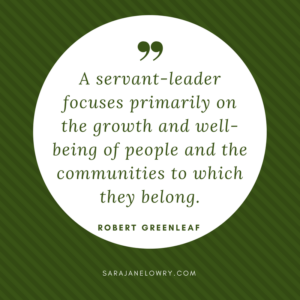 leadership one can choose in our world today. Certain types
 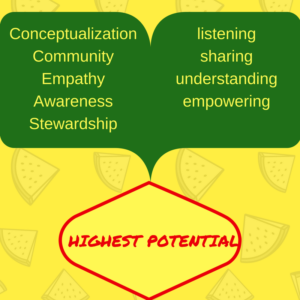 As a servant leader, you express care and concern for staff and board members. You show empathy for their challenges

 wise choice as they are in the midst of strategic planning. An experienced interim director keeps all the balls in the air. The right interim will be able to add some new networks and processes to the organization.